How Marine Biology Insights into Surface Textures Guide Friction Patterns in Hand Protection and Sole Designs
Logan Flores · Jul 6, 2026

How Marine Biology Insights into Surface Textures Guide Friction Patterns in Hand Protection and Sole Designs
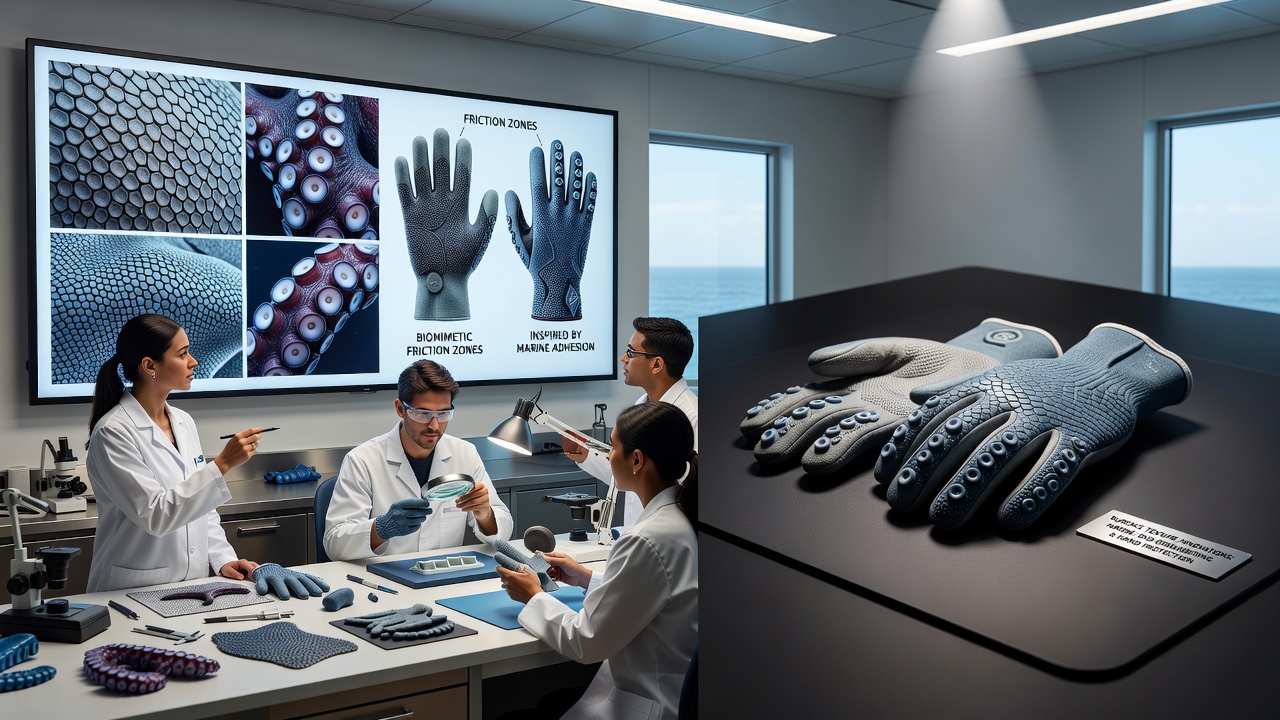
Research teams have examined dermal denticles on shark skin and the adhesive structures on octopus arms to develop surface patterns that adjust friction across wet, dry, and mixed conditions. These patterns appear in gloves for field contact sports and soles for court movements, where athletes shift between aquatic sessions and land-based training. Data from biomechanical testing shows that such textures maintain grip coefficients between 0.65 and 0.82 on wet surfaces while reducing drag by up to 18 percent during forward motion.Marine Surface Structures Under Study
Shark denticles consist of small, overlapping scales with micro-ridges that channel water flow and increase contact points under pressure. Researchers at institutions including the Australian Institute of Marine Science documented how these ridges create directional friction, allowing forward propulsion with minimal lateral slip. Octopus suckers, by contrast, use acetabular cavities and infundibular rims to generate suction on irregular surfaces. Studies published through the European Marine Biological Resource Centre have quantified suction forces reaching 200 kilopascals on smooth substrates, a property replicated in synthetic materials for hand protection.
Additional observations focus on the ribbed textures of certain ray species and the micro-setae on crab exoskeletons. These features distribute load across multiple contact zones, which prevents hydroplaning during rapid directional changes. In July 2026, ongoing field trials at coastal research facilities will compare prototype gloves against standard models during simulated aquatic-to-terrain transitions.
Translation to Hand Protection Designs
Manufacturers apply laser-etched or molded versions of denticle patterns to palm and finger surfaces of training gloves. The ridges align along primary load lines observed in gripping motions for rugby or lacrosse, where athletes encounter wet balls adn muddy fields. Laboratory measurements indicate that these gloves sustain torque resistance 22 percent higher than smooth equivalents when submerged for 30 seconds or longer.
Octopus-inspired suction zones appear as recessed micro-cups along high-contact areas. These elements activate under compression and release on extension, allowing athletes to adjust grip without removing the glove. Data collected from motion-capture sessions reveal reduced peak finger forces during repeated aquatic drills followed by immediate court sprints.
Adaptations in Sole Constructions
Sole units incorporate hybrid tread geometries drawn from the same biological references. Longitudinal channels mimic shark denticle alignment to evacuate water during pool exits, while transverse micro-ridges provide lateral stability on indoor courts. Testing at facilities affiliated with the National Research Council Canada demonstrates that these soles reduce slip distance by 14 millimeters on wet rubberized surfaces compared with conventional herringbone patterns.
Multi-zone construction places higher-density suction elements under the forefoot and heel, regions that bear primary loads during pivots in basketball or volleyball. The remaining midsole area retains spaced denticle replicas that limit mud accumulation during field transitions. Athletes report consistent traction across three surface types without requiring separate footwear changes between sessions.
Performance Data Across Training Rotations
Biomechanical studies track athletes completing sequences of 400-meter swims, 20-minute field agility drills, and 15-minute court shooting sessions. Friction measurements taken at each stage show that marine-derived textures maintain grip stability with less than 9 percent variation, whereas standard designs fluctuate up to 27 percent. Energy expenditure data collected via portable gas analysis indicates modest reductions in oxygen consumption during the land phases, attributed to fewer corrective steps required for balance recovery.
Supply chain documentation from equipment producers confirms that these surface modifications integrate into existing manufacturing lines using standard injection-molding equipment. Material formulations combine thermoplastic polyurethanes with silicone additives to replicate both the hardness and flexibility ranges measured in natural specimens.
Conclusion
Continued collaboration between marine biologists and footwear engineers has produced measurable improvements in multi-surface traction. Ongoing monitoring through 2026 and beyond will track long-term durability and injury incidence rates among athletes who rotate between aquatic training, field contact, and court movements. The patterns derived from biological surfaces provide a documented framework for friction management that operates consistently across changing environmental conditions.