Historical Shifts in Stitching Methods for Leather Components Across Boxing Gloves, Footballs, and Cycling Saddles
Zara Russell · Aug 13, 2026
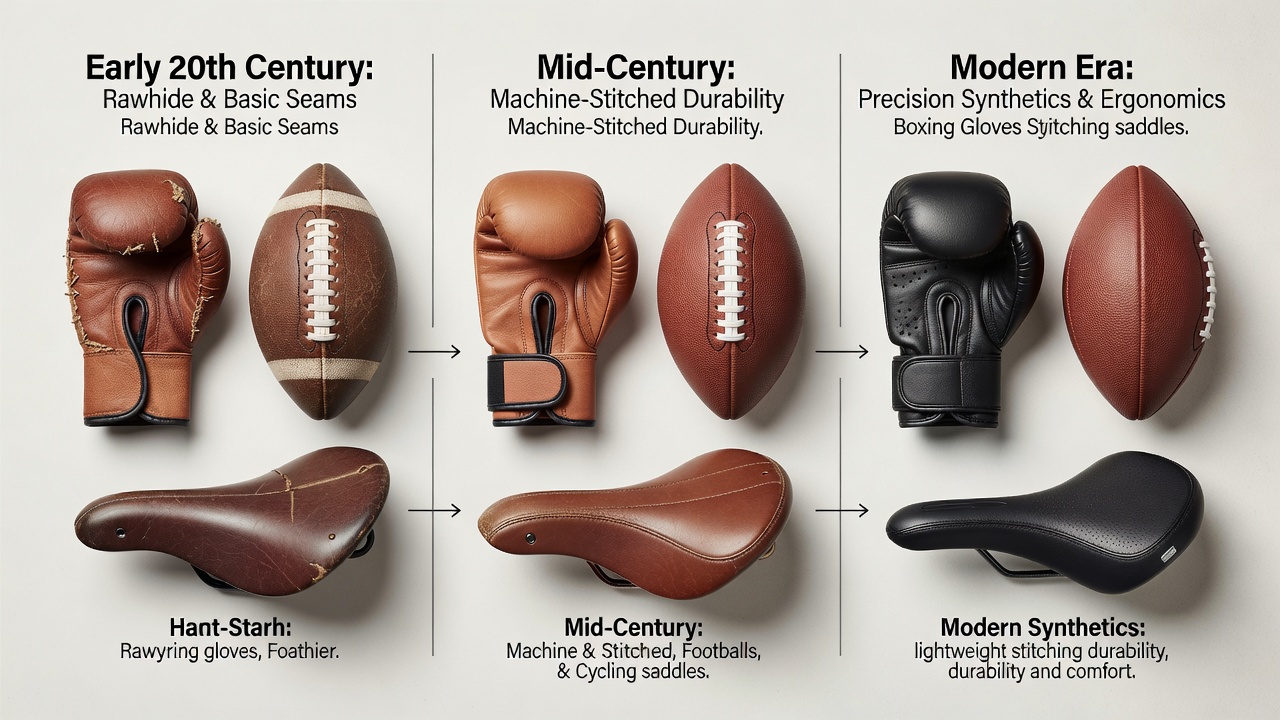
Historical Shifts in Stitching Methods for Leather Components Across Boxing Gloves, Footballs, and Cycling Saddles
Leather components in boxing gloves, footballs, and cycling saddles have undergone measurable changes in stitching methods over the past two centuries, driven by material availability, manufacturing tools, and performance requirements in each sport. Hand-stitching dominated early production, while later developments introduced machine-based approaches that altered seam strength, flexibility, and durability across these items.
Early Hand-Stitching Practices in the 19th Century
Boxing gloves from the mid-1800s relied on saddle stitching with waxed linen thread through pre-punched holes in vegetable-tanned leather, a method that created interlocking seams resistant to repeated impact. Footballs during the same period used similar hand techniques where panels joined along curved edges with two-needle construction, producing the characteristic raised seams still visible in surviving examples from that era. Cycling saddles, first appearing in the 1860s, incorporated leather tops stitched to steel frames using straight stitches that allowed limited flex while maintaining tension across the seat surface.
Research from the Leather Working Group indicates that thread tension and stitch density varied by region, with European makers favoring tighter spacing than their American counterparts in the same decades. These manual processes required skilled workers who adjusted stitch length based on leather thickness, typically ranging between 3 and 5 millimeters for gloves and saddles alike.
Introduction of Lockstitch Machines in the Early 20th Century
By the 1920s, lockstitch sewing machines reached commercial use in sports equipment factories, replacing much of the handwork in boxing glove production. The new method fed thread from two sources to form knots inside the leather layers, resulting in seams that resisted unraveling even after heavy use. Football manufacturers adopted similar machines for panel assembly, though the curved surfaces still demanded partial hand finishing near the valve area.
Cycling saddle producers shifted more gradually, retaining hand-stitching for premium models while applying machine lockstitch to mass-market versions. Data from trade records show that machine adoption reduced production time by roughly 40 percent in larger facilities, yet stitch quality depended on consistent leather preparation that many smaller workshops struggled to maintain.
Post-War Developments and Synthetic Thread Integration
After 1945, nylon and polyester threads entered leather stitching applications, offering greater tensile strength than traditional linen or cotton. Boxing glove seams benefited from these threads because they maintained integrity under repeated compression, while football panels gained resistance to moisture-induced rot along the stitches. Cycling saddles incorporated the new threads primarily in areas subject to constant flexing from rider movement.
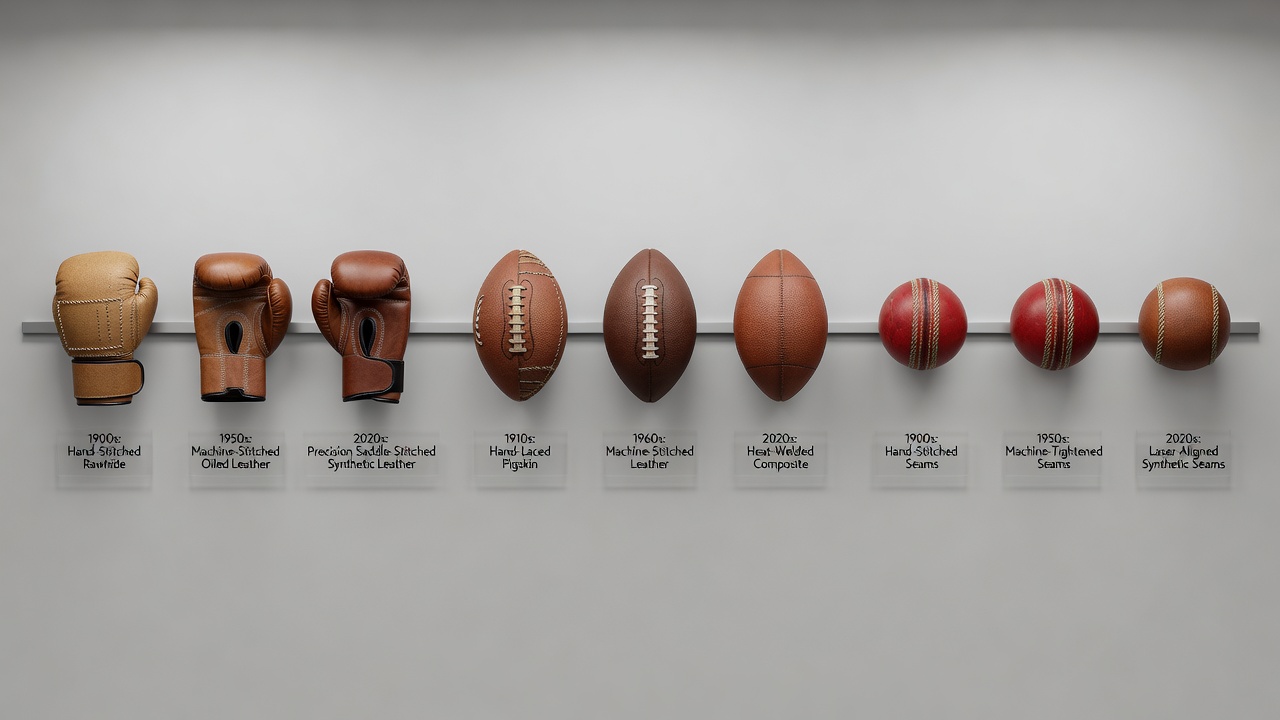
According to records maintained by the Australian Leather Research Association, thread diameter decreased during this period as machines handled finer gauges without breaking, allowing denser stitch patterns that improved water resistance. Observers note that some traditional makers continued using waxed linen for high-end cycling saddles well into the 1970s because riders preferred the grip and aging characteristics of natural thread.
Late 20th Century Refinements and Regional Variations
Computer-controlled stitching equipment appeared in the 1980s, enabling precise seam paths on complex curves required for modern footballs. Boxing glove manufacturers used these systems to standardize stitch counts across production runs, reducing variation between individual units. Cycling saddle makers applied similar technology to reinforce stress points near the frame attachment rails.
Regional differences persisted, with Italian producers favoring chain-stitch variants for certain saddle models while Japanese facilities emphasized flat-lock techniques on gloves. Figures from industry reports reveal that by the early 2000s, over 85 percent of commercial footballs featured fully machine-stitched panels, though some tournament-grade items retained limited handwork at critical junctions.
Current Practices and Documentation Efforts
In August 2026, archival projects at several European museums documented surviving examples of pre-1920 stitching across all three equipment categories, providing baseline measurements for stitch density and thread composition. These efforts rely on non-destructive analysis to compare historical samples with contemporary production methods that still employ leather in select high-end lines.
Modern stitching in boxing gloves often combines synthetic thread with reinforced backstitching at impact zones, while footballs increasingly use bonded panels supplemented by minimal stitching for structural integrity. Cycling saddles have seen a return to selective hand-stitching in artisanal workshops, though machine methods remain standard for volume production.
Conclusion
Stitching methods for leather components in boxing gloves, footballs, and cycling saddles evolved from labor-intensive hand techniques to machine-assisted processes that improved consistency and output. Each sport retained distinct requirements that influenced which stitches persisted or adapted over time, and documentation projects continue to record these changes for future reference.