Altitude's Overlooked Effects on Ball Pressure Standards in High-Elevation Basketball, Volleyball, and Football Competitions
Jonas Schmitt · Jun 27, 2026
Altitude's Overlooked Effects on Ball Pressure Standards in High-Elevation Basketball, Volleyball, and Football Competitions
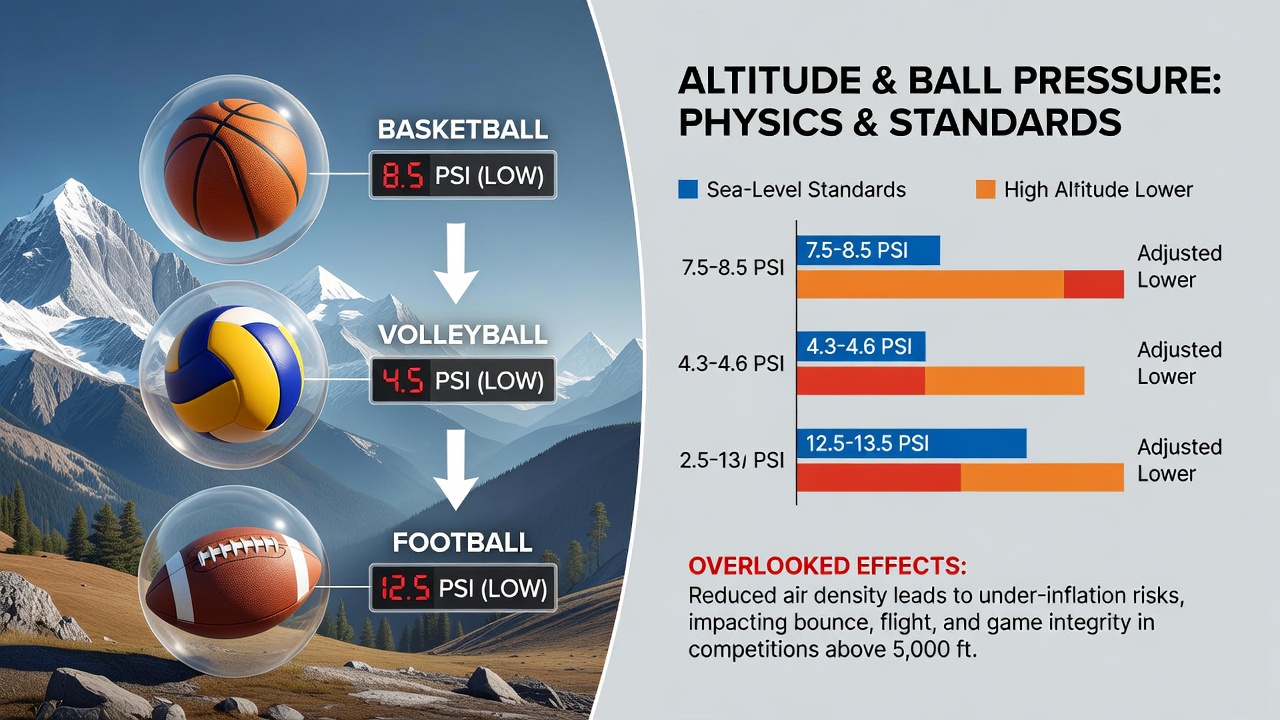
Atmospheric pressure drops steadily as elevation rises, and this change alters the way inflated balls behave once they leave the point of manufacture or the calibration lab, while governing bodies maintain fixed pressure ranges measured at sea level; observers note that teams competing above 1,500 meters must adjust inflation practices or accept performance shifts that rules do not yet address directly.
According to measurements collected by researchers at teh University of Colorado, every 1,000-meter gain in altitude reduces ambient pressure by roughly 11 percent, which means a ball inflated to the lower end of the allowed range at sea level will sit noticeably softer once it reaches Denver or Mexico City; the same ball inflated to the upper end of the range may exceed the permitted maximum once external pressure falls, yet match officials still check only the stated figures without altitude correction.
Physics of Pressure at Elevation
Boyle's law states that the volume of a gas varies inversely with surrounding pressure when temperature stays constant, and this relationship governs every inflated sphere used in court and field sports; data collected during training camps in La Paz, Bolivia, showed that a volleyball inflated to 0.30 bar gauge at sea level expanded enough at 3,650 meters to register 0.34 bar, pushing it outside the upper tolerance allowed by FIVB specifications, while a football prepared at the same lowland site dropped below the lower threshold once transported to the same venue.
Technicians who prepare equipment for international events therefore monitor both gauge and absolute pressure, yet current rule books continue to publish only gauge values calibrated near sea level; as a result, pre-match inspections conducted at high venues sometimes reject balls that would have passed the identical test at lower elevations.
Application Across Three Sports
Basketball leagues that schedule games in Salt Lake City or Bogotá have recorded higher rates of low-pressure complaints during the first quarter when teams arrive with balls inflated at their home arenas, whereas volleyball federations report that seams on match balls can stretch beyond tolerance after only one set at elevation because internal pressure rises against a thinner atmosphere; in football, governing bodies such as CONMEBOL have documented that match balls used in Andean stadiums lose rebound height on artificial surfaces when they arrive under-inflated relative to local conditions.
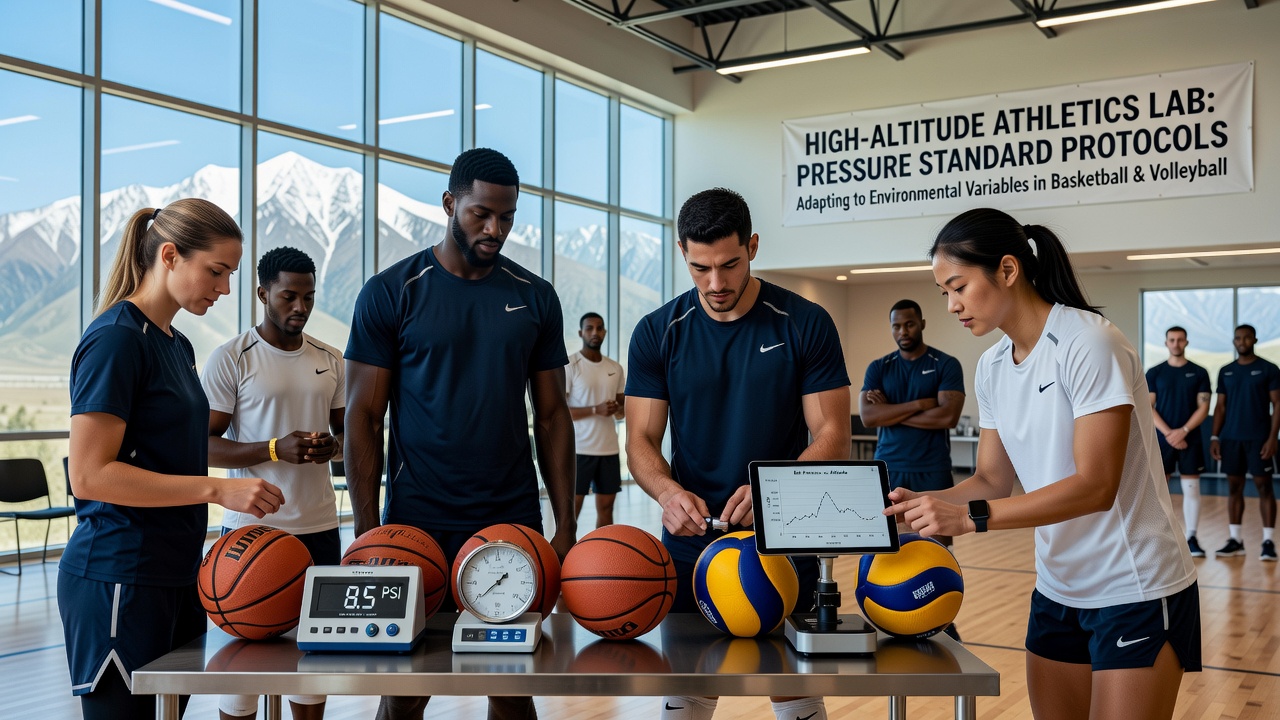
Coaches who travel with portable digital manometers now recalibrate on arrival, but the practice remains unofficial because no federation has published an altitude-adjusted table that officials must follow.
Regulatory Gaps and Emerging Discussions
FIFA technical reports compiled in Switzerland list pressure ranges for match balls without reference to venue elevation, while the NCAA playing rules committee in the United States has acknowledged the issue in committee minutes yet has not altered the published standards; in June 2026, a joint working group formed by FIBA Americas and the South American Football Confederation is scheduled to review whether a sliding scale based on venue altitude should be introduced for qualifying tournaments.
Until that review produces a formal recommendation, equipment managers continue to rely on trial-and-error adjustments that differ from one team to the next, creating inconsistencies that affect both player safety and statistical comparisons across venues.
Practical Adjustments Observed in Competition
Teams based permanently at elevation often store balls at a slightly lower gauge so the spheres reach the correct feel after transport from lower sites, whereas visiting squads that inflate equipment on game day sometimes discover the balls become too firm once play begins; in volleyball, servers have noted that a properly adjusted ball travels farther and drops faster at altitude because reduced drag combines with the altered internal pressure, while goalkeepers in football report that a ball inflated to the upper range at 2,200 meters can feel noticeably heavier on impact than the same model used at sea level.
These differences remain within the margin of human adaptation for most athletes, yet they accumulate across long tournaments and can influence outcomes when margins are narrow.
Measurement Tools and Calibration Practices
Portable absolute-pressure gauges calibrated against local barometric readings now appear in many professional equipment kits, allowing staff to convert between gauge and absolute values on site; manufacturers have begun supplying dual-scale charts with new shipments, yet these charts are not mandatory under existing regulations and therefore see uneven adoption across federations.
Studies conducted by the Australian Institute of Sport compared rebound characteristics of balls prepared under both corrected and uncorrected protocols at simulated altitude and confirmed measurable differences in flight time and contact force, reinforcing the need for consistent preparation standards at every venue.
Conclusion
High-elevation competitions expose a disconnect between published pressure standards and actual environmental conditions that affects basketball, volleyball, and football in measurable ways; until governing bodies adopt altitude-specific tables or require absolute-pressure verification, equipment preparation will continue to rely on local knowledge rather than uniform regulation, leaving an observable variable unaddressed in official protocols.